The IRS 2027 standard deduction for seniors over 65 depends on whether you mean a return filed in 2027 or income earned during 2027. Most returns filed in 2027 cover tax year 2026. For those returns, a single filer age 65 or older has an $18,150 standard deduction before any separate enhanced senior deduction. A married couple filing jointly with both spouses 65 or older has a $35,500 standard deduction.
Eligible seniors may also claim a separate deduction of up to $6,000 per person under current law. That can bring the combined deduction to $24,150 for an eligible single filer or $47,500 for an eligible joint-filing couple, subject to income limits and the assumptions below.
Tax year 2027 update: The inflation-adjusted base standard deduction and age-related additional amounts for income earned in 2027 were not confirmed in the official IRS sources reviewed for this article. The dollar amounts labeled 2026 below are confirmed 2026 figures, not estimates for tax year 2027. The separate $6,000 senior deduction is authorized for 2025 through 2028 under current law. [1–3]
Last fact check: October 17, 2026 · U.S. federal income taxes
IRS 2027 Standard Deduction for Seniors Over 65 and the Tax Year
Start with the tax year printed on your return. The filing date alone does not tell you which deduction amounts to use. Filing a prior-year return late also does not entitle you to the current year’s deduction.
| Your situation | Tax year to use | Usual filing year |
|---|---|---|
| Reporting income earned in 2026 | 2026 | 2027 |
| Reporting income earned in 2027 | 2027 | 2028 |
The IRS expressly states that its 2026 inflation adjustments generally apply to returns filed in 2027. A table showing a $15,750 single base deduction or a $31,500 joint base deduction is showing 2025 amounts, even if the surrounding headline says 2027. [1]
How the Standard Deduction for Seniors Over 65 Works
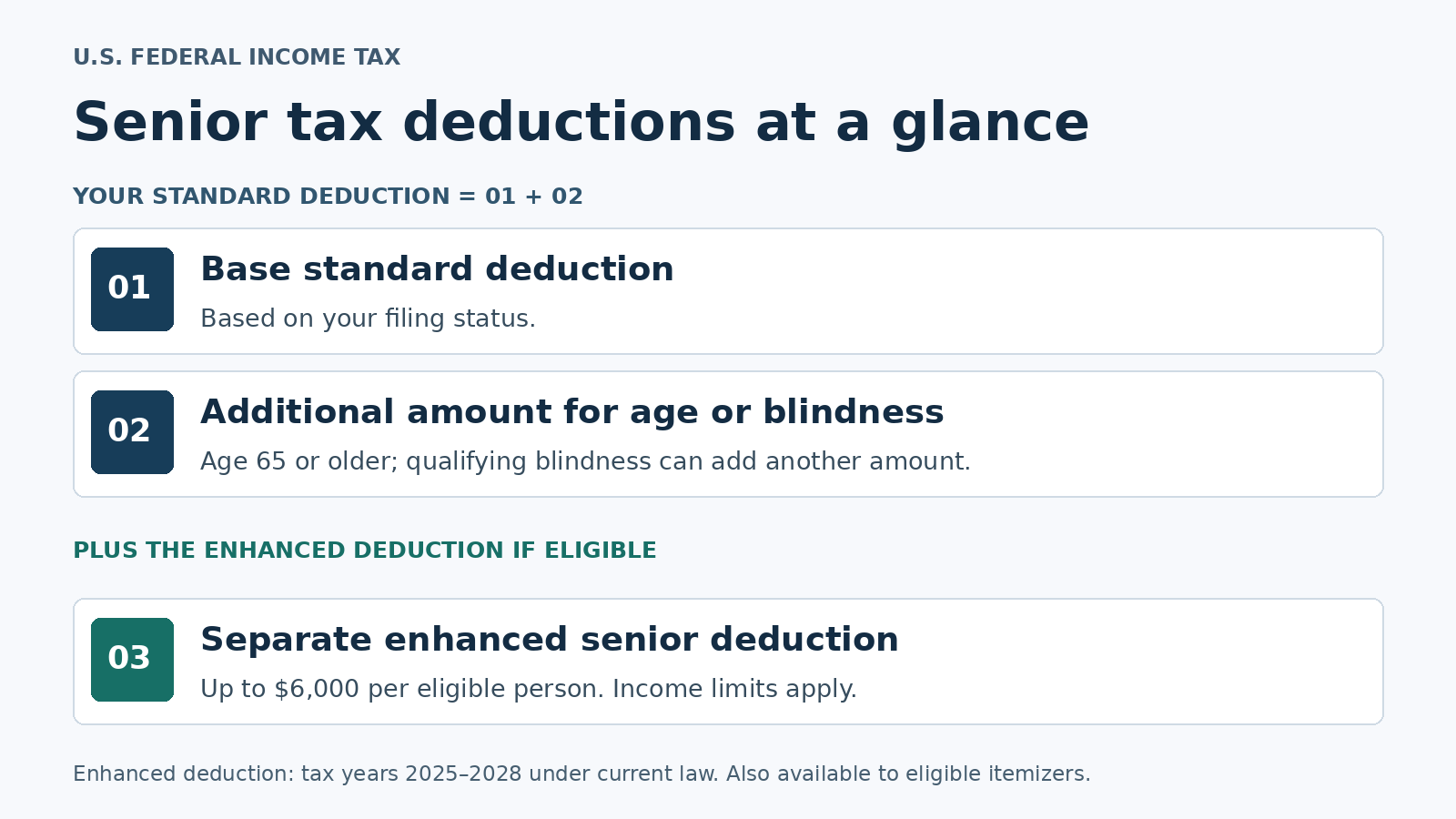
There are three amounts to understand. Two form your standard deduction; the third is claimed separately. Keeping them separate makes it easier to compare filing options and understand income limits.
Base Standard Deduction
This is the deduction associated with your filing status. You generally claim either the standard deduction or eligible itemized deductions. You do not need receipts for ordinary expenses to claim the standard deduction.
Additional Standard Deduction for Age 65 or Blindness
If you qualify because of age, your standard deduction increases. A separate increase can apply for qualifying blindness. A person who qualifies under both rules can receive both additional amounts. These additions belong to the standard deduction and do not apply when you itemize. [4]
Enhanced Senior Deduction of Up to $6,000
The enhanced deduction is an additional tax benefit for eligible people age 65 or older. Under current law, it applies for tax years 2025 through 2028. It can be claimed with either the standard deduction or itemized deductions, but its amount falls as modified adjusted gross income rises. [3]
Standard Deduction for Seniors Filing Taxes in 2027
The following table uses tax year 2026 amounts, generally reported on returns filed in 2027. It assumes no blindness, no dependent limitation, and eligibility to take the standard deduction. The final column also assumes full eligibility for the enhanced senior deduction with no income phaseout.
| Filing status and age | Base deduction | Age addition | Standard deduction total | Combined with full senior deduction |
|---|---|---|---|---|
| Single and 65 or older | $16,100 | $2,050 | $18,150 | $24,150 |
| Head of household and 65 or older | $24,150 | $2,050 | $26,200 | $32,200 |
| Married filing jointly with one spouse 65 or older | $32,200 | $1,650 | $33,850 | $39,850 |
| Married filing jointly with both spouses 65 or older | $32,200 | $3,300 | $35,500 | $47,500 |
| Married filing separately and 65 or older | $16,100 | $1,650 | $17,750 | $17,750; no enhanced senior deduction |
Read the last column carefully: These are combined deduction amounts, not refund amounts or guaranteed tax-free income thresholds. The $6,000 or $12,000 enhanced deduction is separate from the standard deduction. Married filing separately taxpayers generally cannot take a standard deduction if their spouse itemizes. [2–4]
Qualifying surviving spouse is another filing status. For 2026, its base standard deduction is $32,200, with a $1,650 age addition for an eligible filer. Its enhanced senior deduction uses the $75,000 phaseout starting point because the return is not a joint return. Check the eligibility rules before selecting this status. [2,5]
Who Qualifies for Senior Tax Deductions at Age 65?
Age 65 Eligibility for Tax Years 2026 and 2027
You qualify at age 65; you do not need to be 66. The IRS generally treats you as reaching age 65 on the day before your 65th birthday. Applying that rule, the 2026 age cutoff is birth before January 2, 1962. For tax year 2027, the corresponding cutoff is birth before January 2, 1963. The 2027 date is an application of the existing age rule, not a newly announced dollar allowance. [6]
Extra Requirements for the Enhanced Senior Deduction
Each person claiming the enhanced deduction needs a qualifying Social Security number. Current IRS guidance defines this as an SSN valid for employment and issued by the return’s due date, including extensions. If you are married, you must file jointly to claim this deduction. Only the spouse who meets the age and SSN requirements receives the benefit when the other spouse does not qualify. [6]
Retirement and Social Security payments are not requirements. A qualifying 67-year-old who still works can be eligible. Conversely, retiring at 62 does not satisfy the age requirement.
Senior Deduction Income Limits and Phaseout for 2027
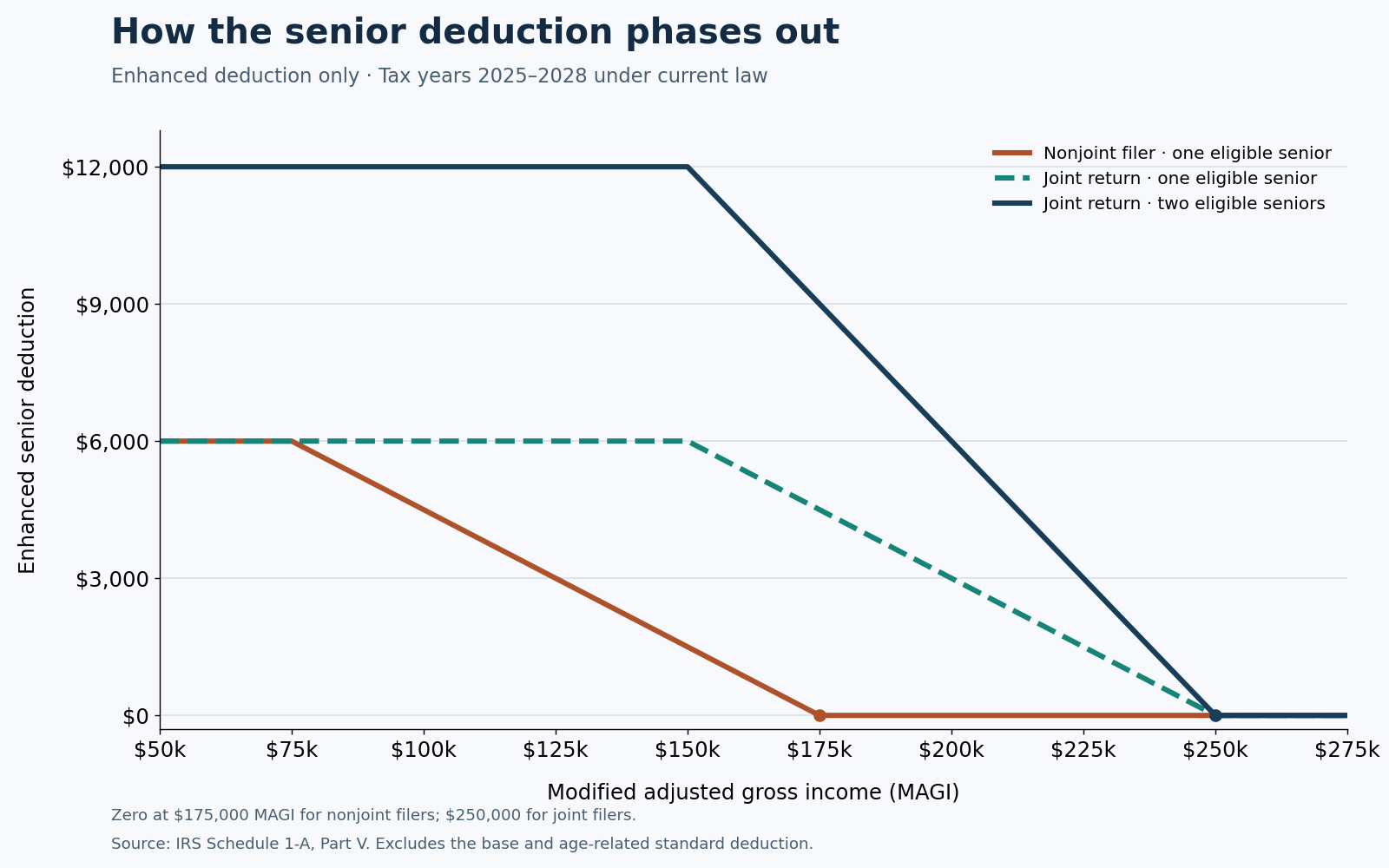
The enhanced deduction’s income limits apply during its 2025–2028 statutory period, including tax year 2027 under current law. These limits do not phase out the ordinary age-related standard deduction.
| Eligible filing situation | Full deduction through MAGI of | Deduction reaches zero at MAGI of |
|---|---|---|
| Eligible nonjoint filer | $75,000 | $175,000 |
| Married filing jointly with one eligible spouse | $150,000 | $250,000 |
| Married filing jointly with two eligible spouses | $150,000 | $250,000 |
MAGI means modified adjusted gross income. For this deduction, the current Schedule 1-A calculation starts with adjusted gross income and adds back specified excluded foreign or territorial income. It is not simply your total bank deposits, and it is not your income after subtracting the standard deduction. Use the worksheet for the tax year you are filing. [5]
How the Senior Deduction Phaseout Is Calculated
The current Schedule 1-A reduces the $6,000 amount by 6% of MAGI above the applicable starting point, with a minimum of zero. The resulting amount applies to each eligible spouse. For a couple with both spouses eligible, calculate that per-person amount and multiply it by two. This is why both a one-senior couple and a two-senior couple reach zero at $250,000 of joint MAGI. [5]
Senior Standard Deduction Examples for Returns Filed in 2027
These illustrations use confirmed 2026 amounts. Each assumes the taxpayer can claim the standard deduction, is not blind, and qualifies for the enhanced deduction except for any phaseout shown. AGI and MAGI are assumed equal. They illustrate taxable income before other deductions or adjustments that may apply.
Single Senior With $40,000 of Income
Linda is 68 and single. Her AGI is $40,000, including any taxable portion of her retirement income. Her standard deduction is $16,100 plus $2,050 for age, or $18,150. With a full $6,000 enhanced senior deduction, her combined deductions are $24,150. Her taxable income is $40,000 minus $24,150, or $15,850.
Married Couple With Both Spouses Over 65
James and Maria are 70 and 67, file jointly, and have $80,000 of AGI. Their standard deduction is $32,200 plus two $1,650 age additions, totaling $35,500. Their full enhanced deduction is $12,000. Their combined deductions are $47,500, leaving $32,500 of taxable income.
Married Seniors With a Partial Income Phaseout
Robert and Susan both qualify by age and SSN, file jointly, and have $175,000 of MAGI. Their excess over $150,000 is $25,000. Six percent of $25,000 is $1,500, reducing each spouse’s $6,000 amount to $4,500. Their enhanced deduction is therefore $9,000. Adding their $35,500 standard deduction gives combined deductions of $44,500.
A deduction reduces taxable income. For example, a fully usable $6,000 deduction would reduce federal income tax by $720 if all $6,000 otherwise fell in a 12% bracket. It is not a $6,000 tax credit or an automatic $6,000 refund. Actual savings depend on the return.
Should Seniors Take the Standard Deduction or Itemize?
Compare your eligible itemized deductions with your standard deduction including age and blindness additions. Medical expenses, eligible taxes, mortgage interest, and charitable contributions may affect that comparison. Apply the deduction limits and floors for your tax year rather than adding up every payment you made. [7]
Using the 2026 joint example, $40,000 of allowable itemized deductions would exceed the couple’s $35,500 standard deduction. The separate enhanced senior deduction may still be available with either choice. Do not compare $40,000 of itemized deductions with $47,500 of combined deductions; that would count the enhanced deduction on only one side.
Do the Senior Deductions Eliminate Tax on Social Security?
They can lower federal taxable income, but they do not automatically make every Social Security payment tax-free. First calculate how much of your benefits is taxable under the Social Security rules. Then claim the deductions that apply to your return.
If Social Security is your only income, your benefits may already be nontaxable. If you also receive wages, pensions, investment income, or IRA distributions, use the IRS benefit worksheet. A deduction that reduces taxable income to zero does not necessarily mean you have no filing requirement. [8]
How to Claim the Senior Standard Deduction
- Confirm the tax year. Use 2026 rules for a 2026 return, even when you submit it in 2027.
- Enter your correct filing status and date of birth. Include your spouse’s information when filing jointly.
- Check the age and blindness boxes that apply. Review the standard deduction calculation on Form 1040 or Form 1040-SR.
- Compare standard and itemized deductions. Keep records for expenses you plan to itemize.
- Calculate the enhanced senior deduction separately. Current IRS guidance uses Schedule 1-A. Verify the form and instructions for the year being filed.
- Review MAGI and SSN eligibility. Confirm the phaseout before assuming you receive the full $6,000 per person.
Form 1040-SR provides a larger-print filing option for seniors. It does not create a bigger deduction than Form 1040. The IRS Tax Counseling for the Elderly program generally offers free tax assistance to people age 60 or older, with attention to retirement-related questions. [4,6,9]
IRS 2027 Standard Deduction for Seniors Over 65 FAQs
What Is the Standard Deduction for Seniors Over 65 in 2027?
For tax year 2026 returns generally filed in 2027, the standard deduction is $18,150 for a qualifying single filer age 65 or older and $35,500 for a joint-filing couple with both spouses 65 or older, before the separate enhanced deduction. Tax year 2027 inflation-adjusted amounts were not confirmed in the IRS sources reviewed as of October 17, 2026. [1,2]
Is the $6,000 Senior Deduction Available for Tax Year 2027?
Yes, under current law. Its statutory period is tax years 2025 through 2028. Age, SSN, filing status, and income rules still apply. [3]
Can Both Spouses Claim the Enhanced Senior Deduction?
Yes. On a joint return, the maximum is $12,000 when both spouses meet the eligibility requirements. The income phaseout can reduce that amount. [3]
Does Income Above $75,000 Eliminate Every Senior Deduction?
No. That is the enhanced deduction’s phaseout starting point for eligible nonjoint filers. Joint filers use $150,000. The ordinary additional standard deduction for age is separate. [4,5]
Can Seniors Who Itemize Claim the Extra $6,000?
Eligible itemizers can claim the enhanced senior deduction. They cannot also add the age-based standard deduction to their itemized deductions. [3,4]
Do Federal Senior Deductions Also Apply to State Taxes?
Not automatically. This article covers U.S. federal income taxes. Check your state revenue department’s instructions for its deduction amounts and treatment of retirement income.
Official IRS Sources
- IRS 2026 inflation adjustment announcement — base amounts and the distinction between tax year 2026 and filing in 2027.
- Revenue Procedure 2025-32 in Internal Revenue Bulletin 2025-45 — section 4.14 provides the 2026 base and age or blindness additions.
- IRS tax deductions for working Americans and seniors — enhanced deduction period and core eligibility rules.
- IRS Topic 551 on the standard deduction — additional amounts and standard deduction restrictions.
- Current Schedule 1-A — MAGI and the enhanced senior deduction calculation. The available form reviewed is for 2025; use the form for your return’s tax year when filing.
- IRS Publication 554 — senior age rules, SSN requirements, and Form 1040-SR. The edition reviewed is for 2025.
- IRS Topic 501 on whether to itemize — comparison of standard and itemized deductions.
- IRS Topic 423 on Social Security benefits — taxable benefits and filing considerations.
- IRS free tax return preparation programs — VITA and Tax Counseling for the Elderly.
This guide provides general federal tax information. Individual eligibility and tax savings depend on the return. Check the IRS instructions for your tax year or ask a qualified tax professional about your circumstances.